Why do tall buildings sway far from the epicentre?
What long-period ground motion is and why Shindo at ground level does not describe all movement on a high floor.
A JISHINDESU editorial guide based on the cited official and primary materials. It does not replace official safety information.
On this page
Different waves move buildings in different ways
Ground motion contains waves with different periods. In simple terms, the period is the time for one complete cycle of movement. Long-period motion has slower cycles and can travel far from the source.
A person at ground level may not feel a sharp jolt, while a tall building can enter a noticeable, long-lasting sway.
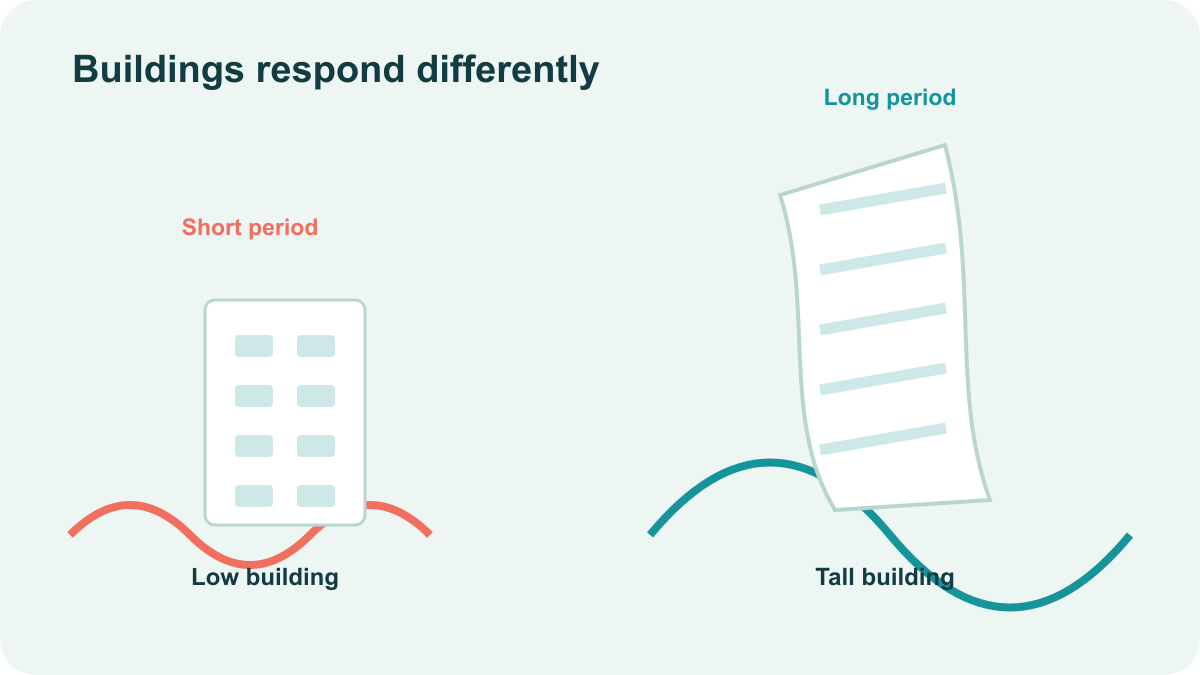
Every building has a natural rhythm
A structure has a natural period: the rhythm at which it sways most readily. Taller buildings generally have longer periods than low buildings. When ground motion matches that response, movement on upper floors can grow.
Not every tower behaves alike. Design, height, damping, condition, ground and the specific floor all matter.
Shindo and long-period class describe different things
Shindo describes shaking at an observation point well, but it was not designed as a complete measure of motion high in a tower. JMA therefore also uses long-period ground motion classes 1 to 4.
The classes relate to effects such as difficulty moving and furniture displacement in tall buildings. They are calculated from station data, not from a sensor on every floor of a particular building.
Why swaying can continue
Long-period waves can travel far, and soft sediment in large basins can prolong or amplify the motion. A moving structure also takes time to settle, so upper floors may keep swaying after street-level motion feels calmer.
Furniture and wheeled objects may move, and lifts may stop for safety. Follow building management and local emergency instructions.
Reading JMA information
Check Shindo and the long-period ground motion class separately when both are available. Do not convert one into the other. Classes 1–4 are not extra Shindo levels.
A regional class is a guide to possible behaviour in tall buildings. Actual motion can differ by building and floor.