What does earthquake depth mean?
A plain-language guide to hypocentre depth and why shallow and deep earthquakes can feel very different.
A JISHINDESU editorial guide based on the cited official and primary materials. It does not replace official safety information.
On this page
Depth tells you where the rupture started
An earthquake begins below the surface. The point where rock first breaks and suddenly moves is called the hypocentre. The depth in an earthquake report is the distance from that point to the surface.
A depth of 10 km therefore means something different from 100 km. It does not tell you how far away the event is horizontally. Read depth together with location and distance from the place you care about.
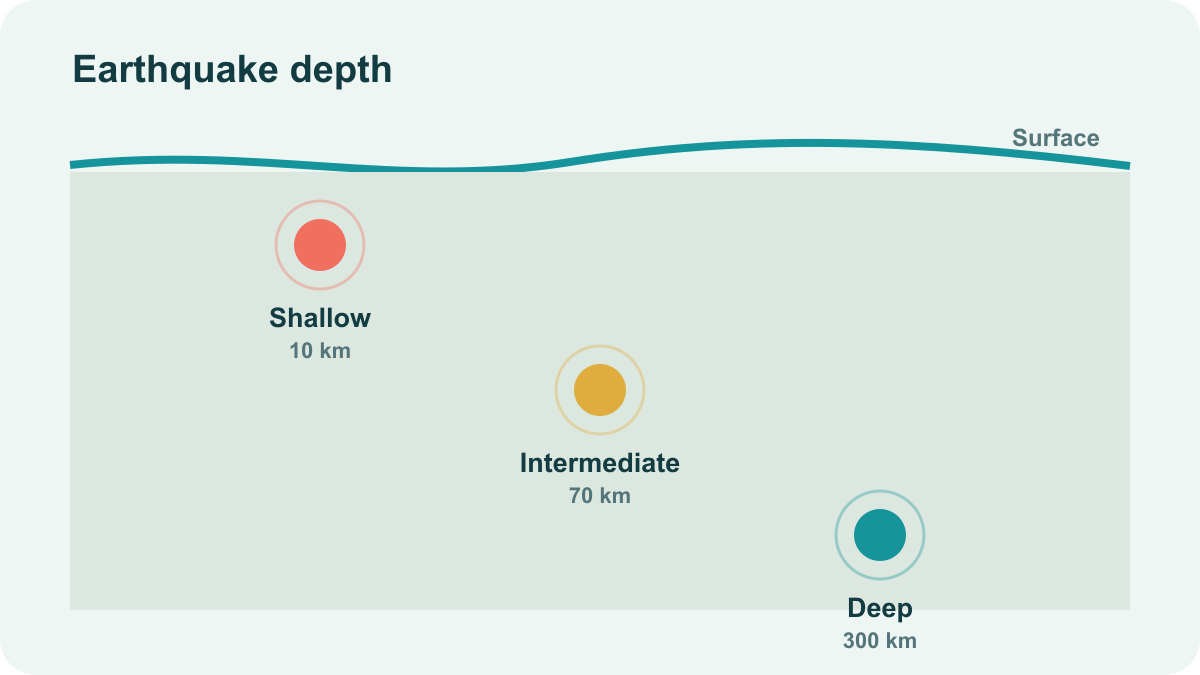
A shallow earthquake can shake nearby places strongly
When the source is shallow, seismic waves have a shorter journey to the surface. Strong local shaking can result even when magnitude is not exceptionally high. This does not make every shallow event dangerous: magnitude, distance, fault movement and local ground all matter.
Imagine two magnitude 5 earthquakes. One begins 10 km below a city. The other begins 120 km deep and farther away. The first can produce higher local Shindo even though the two magnitudes are similar.
A deep earthquake may be felt over a wide area
Waves from a deep source travel a longer path. They can reach many regions, while surface shaking is often weaker than for a similar shallow event directly beneath a place.
This is not a fixed rule. The structure of the Earth can guide waves in different directions, and soft sediment can amplify part of the motion. The nearest municipality does not always record the highest Shindo.
How to read depth in JISHINDESU
First check whether depth is available and whether the report is preliminary. Early estimates may be revised. Then open the Shindo observations instead of judging local shaking from depth alone.
Depth helps explain an event; it is not a safety rating for your home. Use actual observations, official information and local instructions for that.
- Depth locates the source below the surface.
- Magnitude describes the event; Shindo describes local shaking.
- Values in an early report may be corrected.