Aftershocks: what are they and how long can they continue?
Understand mainshocks, aftershocks and swarms—and why a foreshock can only be recognised after a larger event.
A JISHINDESU editorial guide based on the cited official and primary materials. It does not replace official safety information.
On this page
The ground keeps adjusting after a large earthquake
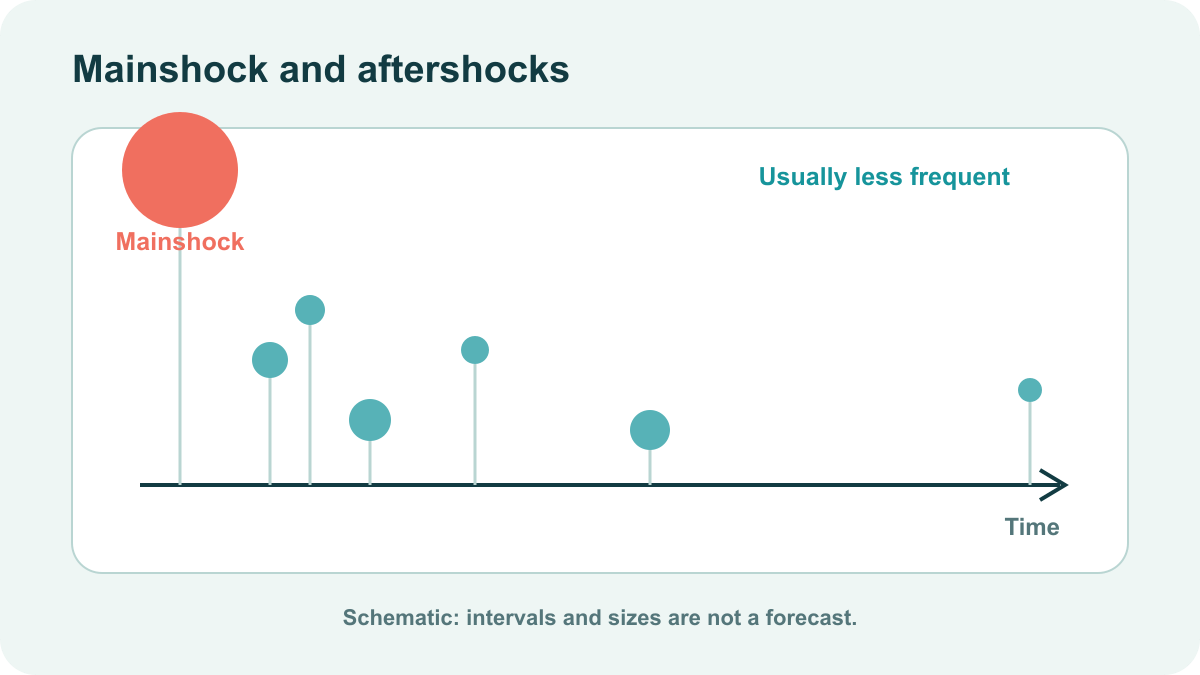
A large earthquake changes the balance of forces in the rock. More earthquakes can follow in and around the rupture area. They are called aftershocks when they belong to the same sequence and are smaller than the event treated as the mainshock.
They are usually most frequent soon after the mainshock and become less common with time. There is no exact finishing time. Activity can continue for weeks or months, and traces of some sequences last much longer.
A foreshock is known only in hindsight
The first earthquake may look like an event on its own. If a larger earthquake later occurs nearby, the earlier one may be called a foreshock. Before the larger event, there is no reliable way to give it that label.
Calling something a foreshock after the fact is not a prediction. A small earthquake by itself is not proof that a larger one is about to occur.
An earthquake swarm follows a different pattern
In a typical sequence, one event clearly dominates and smaller events follow. A swarm can contain many earthquakes of similar size without one obvious mainshock. Activity may rise and fall for a while.
The boundaries are not always clear. Seismologists compare location, time and fault mechanisms. A map can reveal a pattern, but it cannot classify a sequence on its own.
Can the next shock be predicted?
After a large earthquake, scientists can estimate statistically that more earthquakes nearby are more likely than usual. They cannot provide the exact time, location and magnitude of the next event.
After a damaging earthquake, follow JMA and local authorities. Do not enter a damaged building simply because several quiet hours have passed. Further shaking can worsen existing damage.
Following a sequence in JISHINDESU
Open the larger event, then use the map and the history of a selected place. Compare time, location, depth and magnitude. Do not automatically label every later event in the prefecture an aftershock.
A JISHINDESU notification concerns an already reported station reading meeting the configured coverage and Shindo threshold. It is not an Earthquake Early Warning, confirmation of a person's safety or a measurement inside a particular building.