Earthquake swarms: what does repeated shaking in one area mean?
How a swarm differs from a mainshock–aftershock sequence and what it cannot tell us about the next earthquake.
A JISHINDESU editorial guide based on the cited official and primary materials. It does not replace official safety information.
On this page
A swarm has no single obvious mainshock
An earthquake swarm is a concentration of many events in one region without a simple pattern of one large mainshock followed by smaller aftershocks. Several earthquakes may have similar magnitudes, and activity can rise and fall.
The name describes an observed pattern. It does not automatically explain the cause or tell us how the sequence will end.
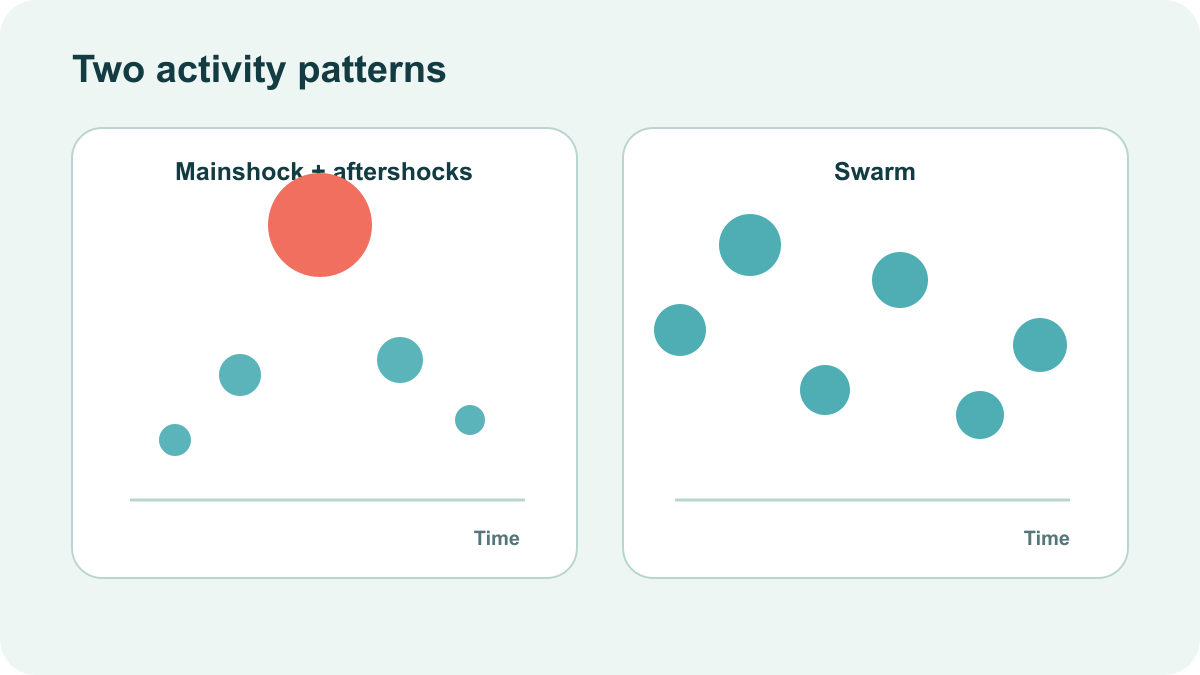
Why swarms occur
Different swarms can have different causes. Changes in stress on faults, movement of fluids underground and volcanic processes may all play a role in different settings.
A cluster of map points is not enough to identify the cause. Scientists need precise seismic data and, depending on the location, other observations.
A swarm does not promise a larger earthquake
Most seismic activity does not follow a simple path toward one large event. A rising number of small points cannot provide the date of a larger earthquake.
Still, respond to each felt event according to its actual Shindo and official information. The inability to predict does not mean ignoring current warnings.
Viewing a swarm on the map
Keep one area and compare several time windows. Check whether events cluster in space, share similar depth and include one earthquake much larger than the rest.
Use the view to understand history. Leave the official assessment to JMA and scientific organisations with fuller datasets.