Epicentre and hypocentre: what is the difference?
Two similar terms describe different points: where rupture begins underground and the point directly above it at the surface.
A JISHINDESU editorial guide based on the cited official and primary materials. It does not replace official safety information.
On this page
The hypocentre is underground
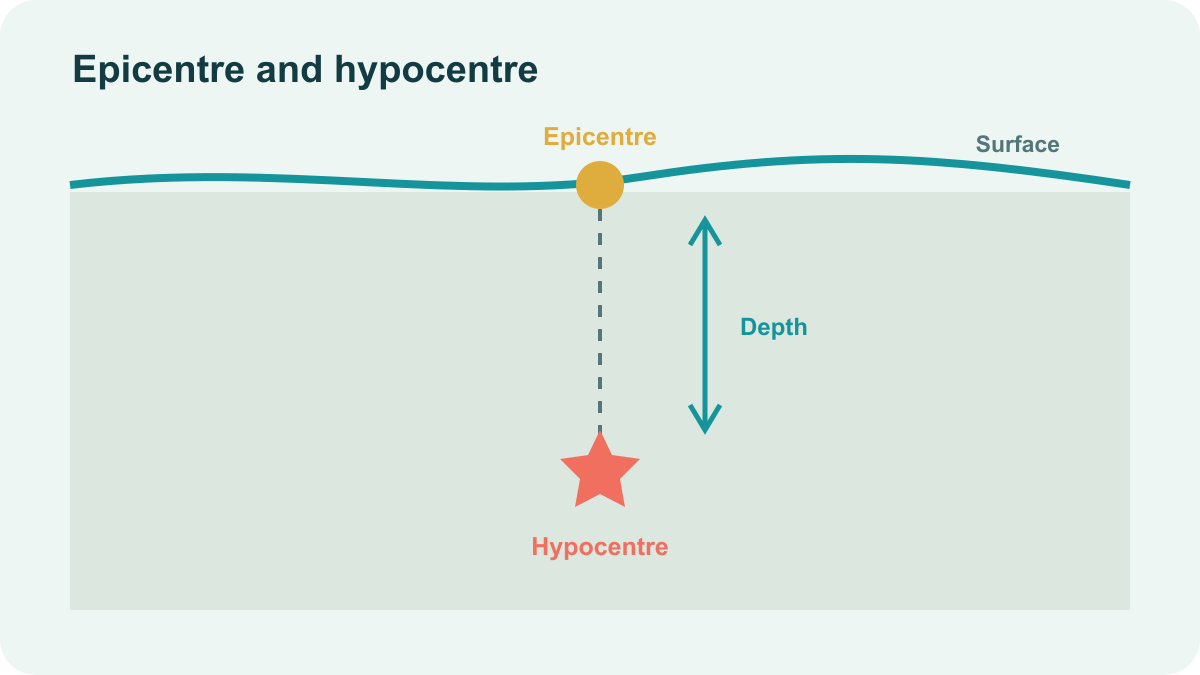
The hypocentre, also called the focus, is the point inside the Earth where rock begins to rupture. Its location is described by coordinates and depth.
Japanese reports often use 震源, shingen. Depending on context, it can refer to the earthquake source or source region.
The epicentre is at the surface
The epicentre is the point on the surface directly above the hypocentre. A simple earthquake map normally uses this point for its event marker.
In Japanese, epicentre is 震央, shin'ō. It is not necessarily the place that recorded the highest Shindo.
One marker does not show the full rupture
A large earthquake is not a perfect point. Rupture may extend for many kilometres along a fault. Two cities equally far from the marker can be at different distances from the actual rupture area.
Waves do not spread equally in every direction either. Distance from the epicentre is a useful shortcut, but it cannot predict local Shindo on its own.
What to check in a report
After locating the epicentre, check depth and magnitude. Then open the actual Shindo observations. They describe how strongly the ground moved at specific stations.
If you care about one city, do not assume that the nearest map marker had the highest reading. Check the municipality and station list.