Japan’s Earthquake Early Warning: what is 緊急地震速報 (kinkyū jishin sokuhō)?
How 緊急地震速報 (kinkyū jishin sokuhō) works, how much time it may provide and how it differs from a JISHINDESU notification.
A JISHINDESU editorial guide based on the cited official and primary materials. It does not replace official safety information.
On this page
It warns about incoming strong waves; it is not a forecast
緊急地震速報, read kinkyū jishin sokuhō, is JMA’s Earthquake Early Warning. It starts working after an earthquake has already begun: sensors detect the first waves and the system quickly estimates where stronger shaking may arrive. A public warning is issued when the predicted shaking meets JMA’s criteria.
It does not predict an earthquake a day or an hour ahead. It uses the short difference between detecting the first wave and the arrival of stronger motion at places farther away.
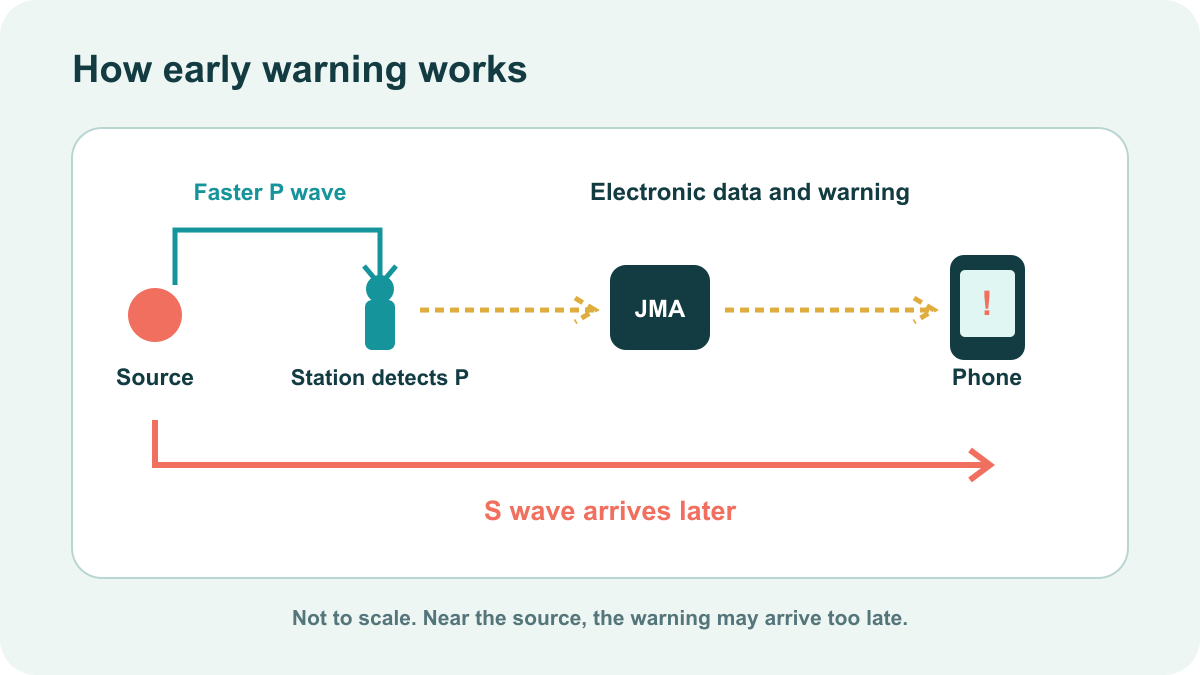
The P wave arrives before the S wave
The P wave moves faster and usually produces weaker motion. The S wave is slower but often brings stronger shaking. When a sensor near the source detects a P wave, electronic data can travel to the warning system faster than the S wave travels through rock.
JMA uses those data to estimate the source, magnitude and expected shaking. Processing is automatic, and estimates can change as more stations report.
You may get seconds—or no warning before shaking
Farther from the source, the warning may provide a few to a few tens of seconds. Close to a shallow earthquake, strong shaking may arrive before or almost together with the warning. Predicted Shindo and arrival times also include uncertainty.
Do not wait for a countdown. When you hear the warning sound, look around and protect your head from falling objects. The aim is a quick, calm response suited to your surroundings.
Where the public warning appears
Public warnings can be delivered through supported phones on Japanese networks, television, radio and local systems. Reception depends on the device, carrier, settings and region.
A phone bought abroad or used in roaming may behave differently from a device on a Japanese network. Check emergency alert support before travelling and do not rely on one app alone.
JMA’s warning and a JISHINDESU notification are different
A JISHINDESU notification concerns an already reported station reading meeting the configured coverage and Shindo threshold. It is not an Earthquake Early Warning, confirmation of a person's safety or a measurement inside a particular building.
Afterward, JISHINDESU helps you inspect the report, actual readings and local history. During danger, official warnings and emergency instructions take priority.