Can every earthquake cause a tsunami?
What creates a tsunami, why magnitude alone is not enough and when to leave the coast immediately.
A JISHINDESU editorial guide based on the cited official and primary materials. It does not replace official safety information.
On this page
A tsunami needs a sudden displacement of a large amount of water
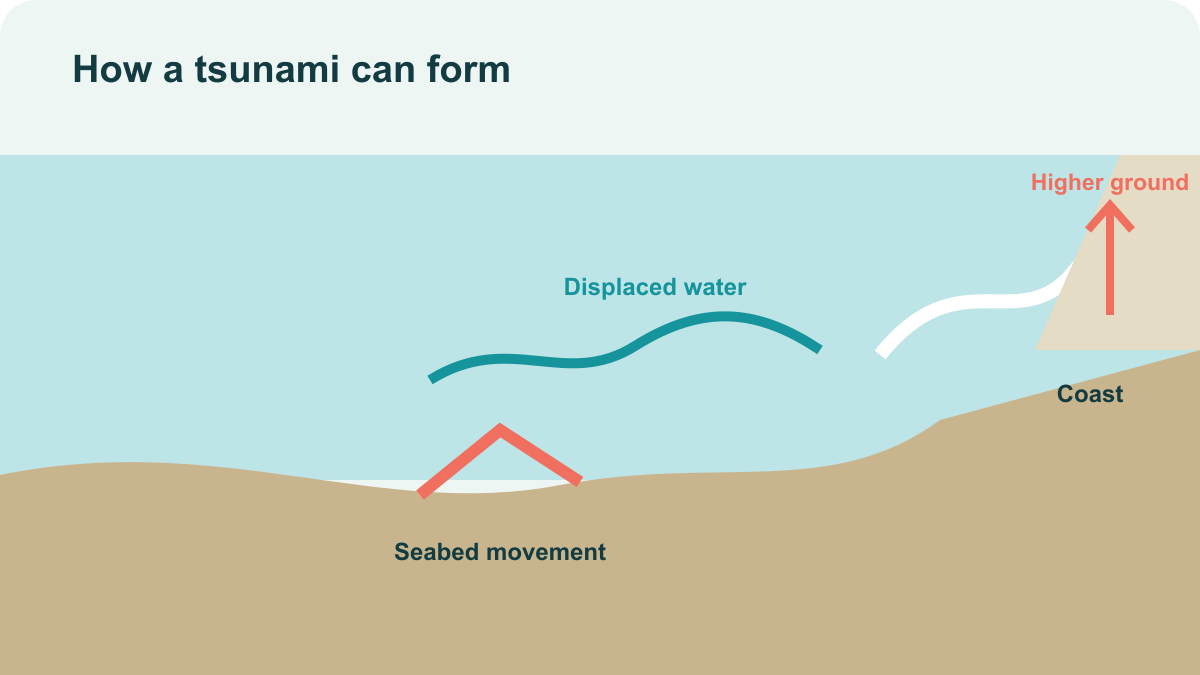
Most earthquakes do not cause a dangerous tsunami. A large wave usually requires an event under the sea or near the coast that moves the seabed in a way that displaces water. Fault movement, rupture size and depth all matter.
A powerful earthquake on land may not cause a tsunami. An offshore event still needs rapid assessment even when shaking at your location does not feel extreme.
Magnitude alone does not answer the question
A higher magnitude usually means a larger source, but not every large earthquake moves the seabed vertically. A deep event or mostly sideways fault movement affects the water differently from a shallow rupture below the seabed.
Do not use one number as a personal safety threshold. JMA combines rapid earthquake estimates with models and sea-level observations, then updates its information.
Strong or long shaking near the coast is a reason to move
If you are near the sea and feel strong shaking, or weaker but long and slow swaying, leave the coast and move to safer, higher ground. Do not wait for a map or an app message. A tsunami may arrive quickly.
Do the same when an official warning or evacuation instruction is issued, even if you did not feel an earthquake. The wave may come from a distant event.
The first wave may not be the largest
Tsunami waves can arrive repeatedly. Water may rise again after the first wave, and dangerous currents can continue for a long time. Never return to the shore to watch or take pictures.
Stay in a safe place until authorities cancel tsunami warnings and advisories. An estimated arrival time does not mean the danger ends immediately afterward.
Using JISHINDESU safely
The report helps you review location, depth, magnitude and tsunami information carried by the source. It provides useful context after an event but does not replace JMA, local warning systems or evacuation orders.
If you are outside the danger zone, you can share the report later. At the coast, reach a safe place first and check details afterward.